Goal (these are in bold sentences): Learn about social psychology through the ‘Social and Environmental Psychology’ elective. This will help me determine the relative impact the stories I want to tell and the medium I tell them through have on the user, and ensure my designs are meaningful.
I learned more about human behavior in Social and Environmental Psychology (SEP), a course from Psychology and Technology. This was a topic that I wanted to delve into and that aligned with my vision from year 1. Kurt Lewin’s equation summarizes it nicely: 
In words, the way one behaves (B) is determined by one’s characteristics (P) and the environment one is in (E). This surprised me. I never imagined that the behavior of such a complex species could be represented by a simple equation (MDC). Designing with More-than-Human Worlds helped me pin my human-centric thinking and consider that we might not be as complicated as I once
believed.
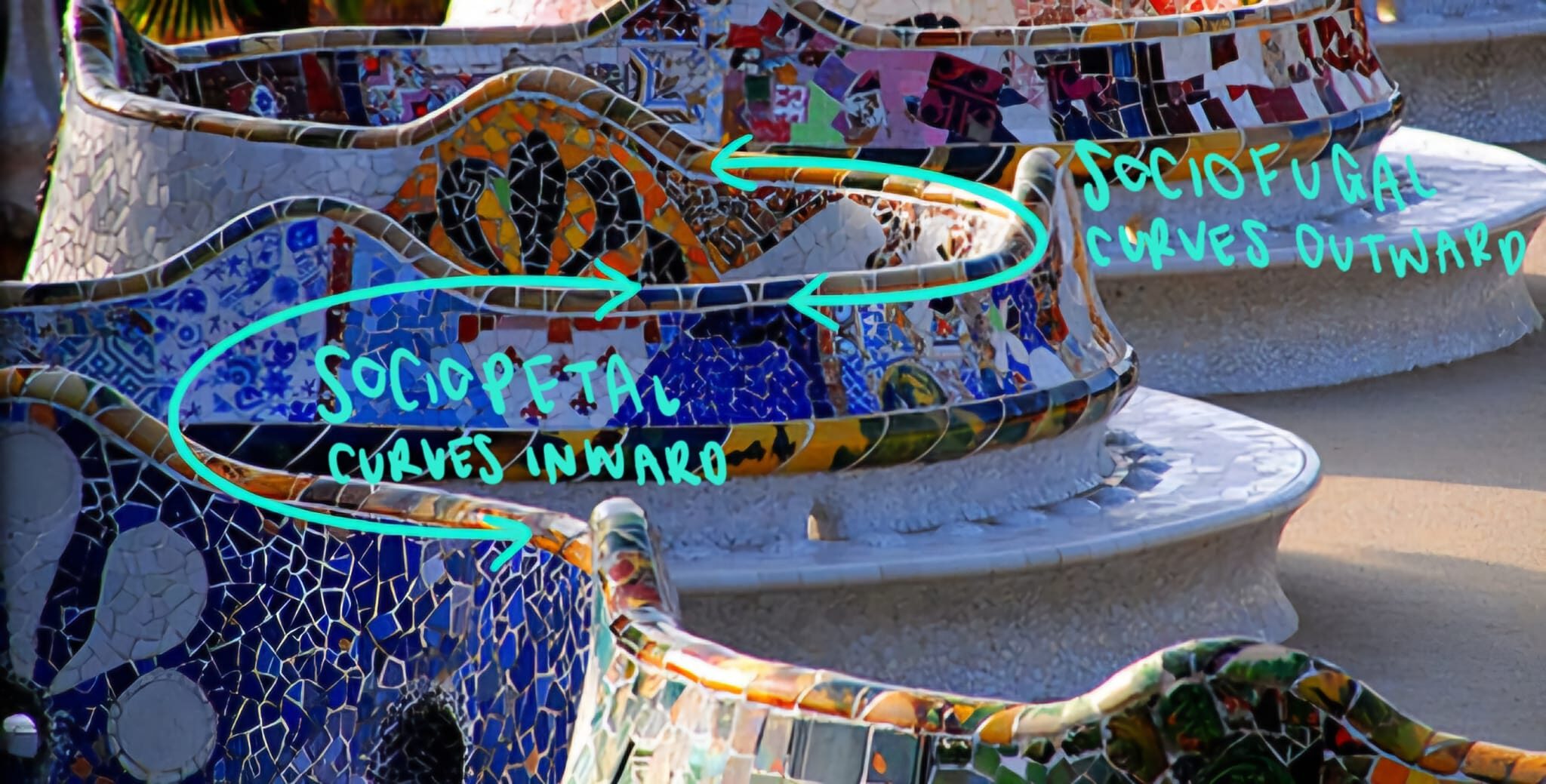
After SEP, I also started applying these concepts to my projects. My CBL-Project 3 in the Transforming Practices squad is an exhibition called ‘The Power of Perspective’ that highlights some of the complexities of human actions and emotions during and after the 1994 Rwandan genocide and hopes to take you beyond simple judgment. To achieve this last part, we wanted to spark conversation through our exhibition so visitors could learn from each other. This reminded me of sociopetal arrangements that promote social interaction (US), like Antoni Gaudí’s benches in Figure 13, which inspired my teammate when thinking about the shape of our exhibition, as shown in Figure 14.